

Picture-Perfect Precision: How Digital X-Rays and Digital Impressions Are Changing Your Dental Visit
October 6, 2026
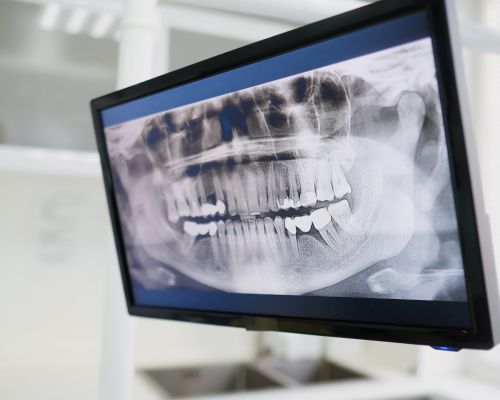
At Radianté Dental and Facial, film X-rays and messy impression trays are things of the past. We use digital X-rays and digital impressions to see more, expose you to less radiation, and make every visit faster and more comfortable.
If you have ever bitten down on a tray of thick, gooey putty or waited for X-ray film to develop, you will notice the difference right away. Here is what these technologies are, how they work, and why they matter for your smile.
Digital X-Rays: A Clearer Look Beneath the Surface
X-rays, also called radiographs, are a form of invisible electromagnetic energy. They pass easily through soft tissue like your lips and cheeks but are absorbed by dense structures like teeth and bone. That contrast lets your dentist see what the naked eye cannot.
Traditional dental X-rays relied on silver-based film that had to be developed in harsh chemical solutions. Digital radiography replaces that film with a small electronic sensor placed in your mouth. The image appears on a screen within seconds, ready for your dentist to review with you.
Risk Factors Include:
Dentists use X-rays to:
● Detect cavities between teeth and under existing fillings
● Examine tooth roots and the bone that supports them
● Spot signs of periodontal (gum) disease
● Evaluate tooth and jaw alignment
● Track tooth development in children and teens
Why Digital X-Rays Are Better for You
● Far less radiation: Digital X-rays use up to 90% less radiation than conventional film, which was already low-risk.
● Instant results: Images appear in seconds, so there is no waiting for film to develop.
● Sharper detail: Your dentist can zoom, adjust contrast, and enhance images to catch small problems early.
● Easier to understand: We show the images on a screen and walk you through what we see.
● Eco-friendly: No film and no caustic developing chemicals that harm the environment.
● Simple sharing: Images can be stored securely and sent to specialists or insurers electronically.
Digital Impressions: Goodbye, Goopy Trays
A dental impression is a precise model of your teeth and gums. It is used to design restorations and appliances that fit you exactly. In the past, that meant biting into a tray of thick putty and holding still while it set.
Digital impressions use a small handheld intraoral scanner instead. The wand glides over your teeth, capturing thousands of images that form an accurate 3D model on screen in minutes.
Patients love digital impressions because they offer:
● More comfort: No bulky trays, no unpleasant taste, and far less gagging.
● Greater accuracy: Detailed 3D scans mean restorations fit better, with fewer adjustments.
● Fewer retakes: Your dentist can check the scan instantly and rescan a small area if needed.
● Faster turnaround: Files go straight to the dental lab electronically, with no shipping of physical molds.
● A preview of results: Seeing your teeth in 3D makes it easier to understand and plan your treatment.
Where You Will See This Technology at Work
Digital X-rays are part of routine checkups and help us diagnose problems early, when treatment is simpler. Digital impressions support many of the treatments we offer, including:
● Crowns and bridges
● Porcelain veneers
● Dental implant restorations
● Clear aligners
● Night guards and sports mouthguards
What to Expect at Your Visit
A digital X-ray takes only a few seconds. You bite gently on a small sensor while the image is captured, then view the results with your dentist right away.
A digital impression usually takes just a few minutes. You relax in the chair while the scanner moves around your mouth. You can breathe, swallow, and take breaks as needed.